
Design your own interface.
Use the cellphone app to personalize colours, graphics, layouts and displayed information. Drivers shape their own GUI, then apply it to the cockpit through NOAH.
NOAH / Evolving cockpit experiences
A cockpit platform that lets drivers design their own HMI appearance and behavior—and apply changes immediately without updating the vehicle’s system software. Keep the cockpit experience evolving after delivery through an OEM-owned service model.
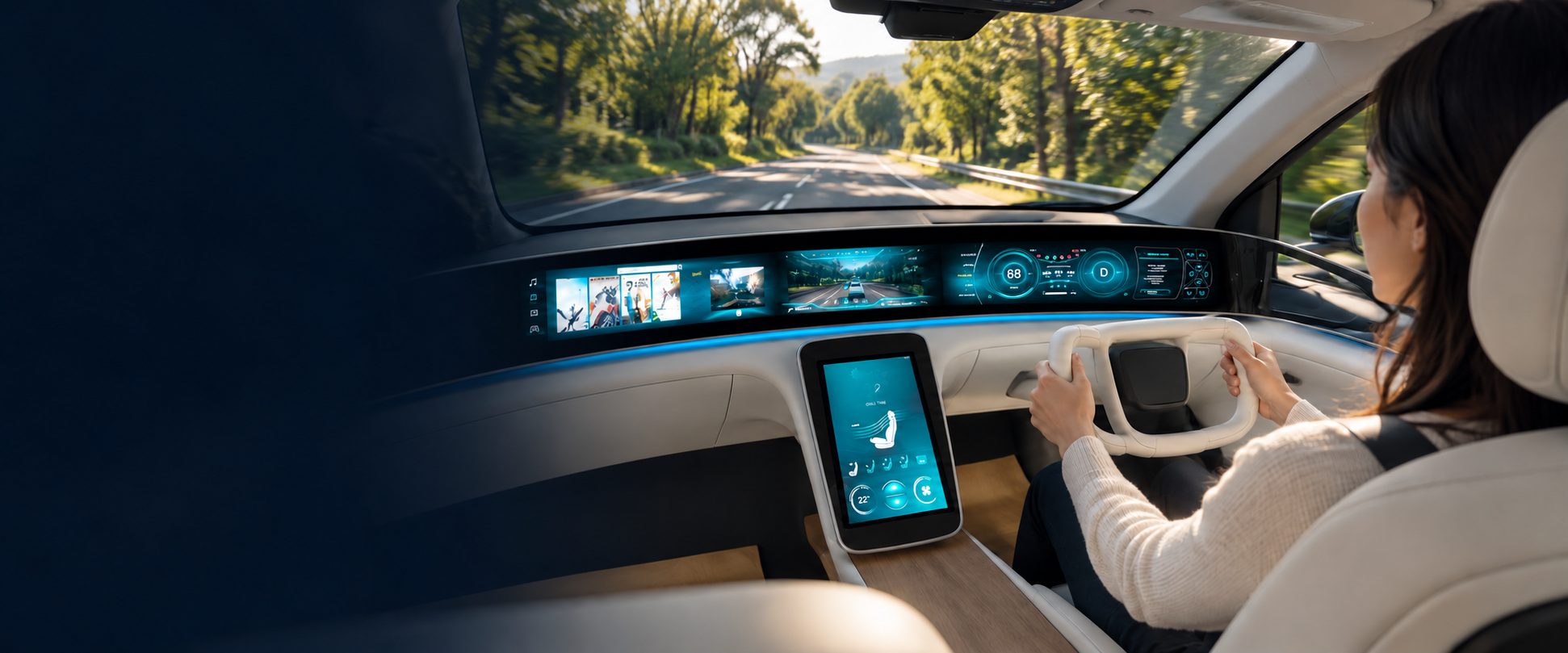
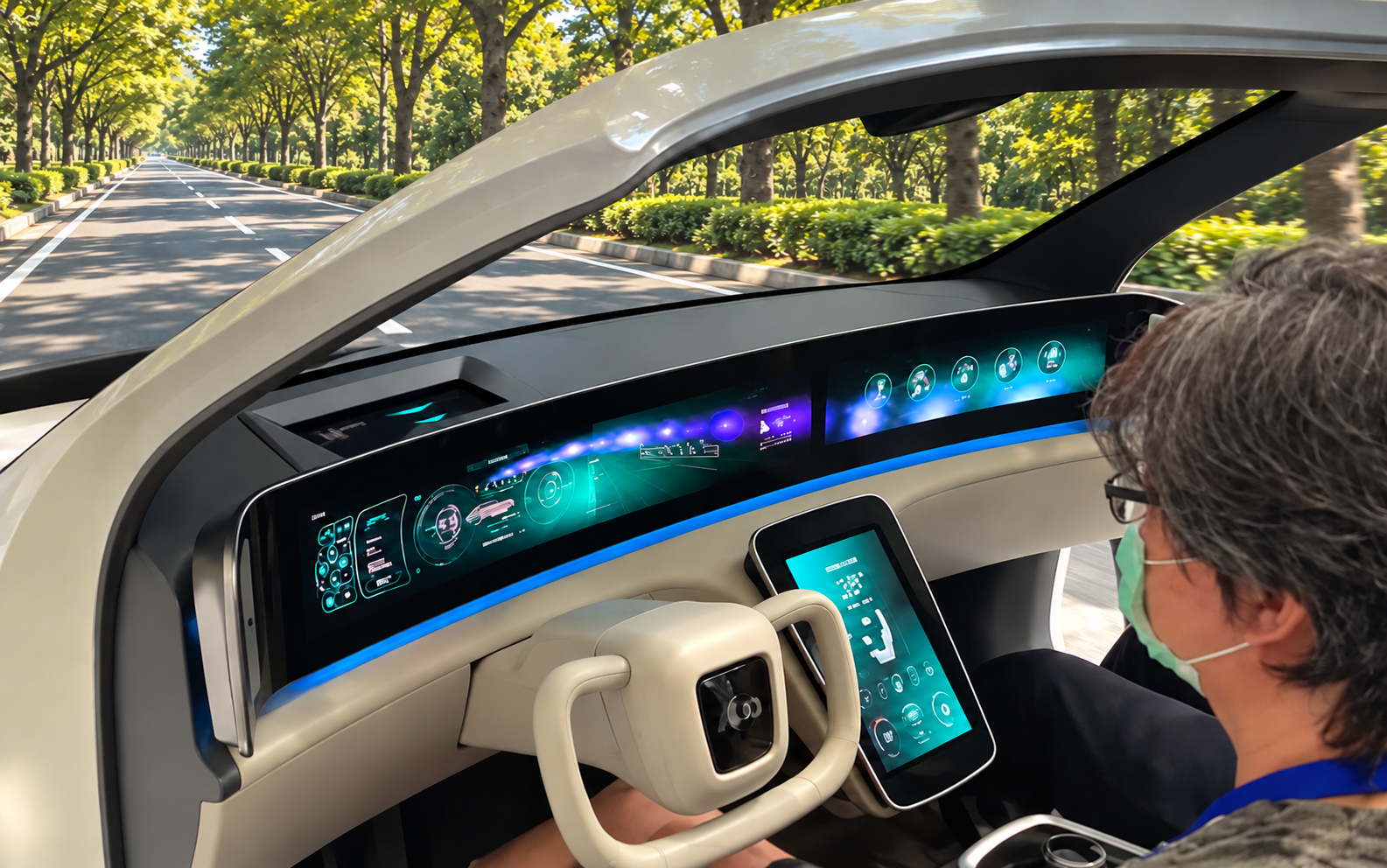
Driving scene: concept visualization.
01 / Driver Experiences
With a cellphone app, drivers design both the GUI they see and the behavior they want. NOAH brings their design into the cockpit immediately, without changing vehicle hardware or the system binary, and without restart or reboot.

She chooses a playful 3D world around her driving information.
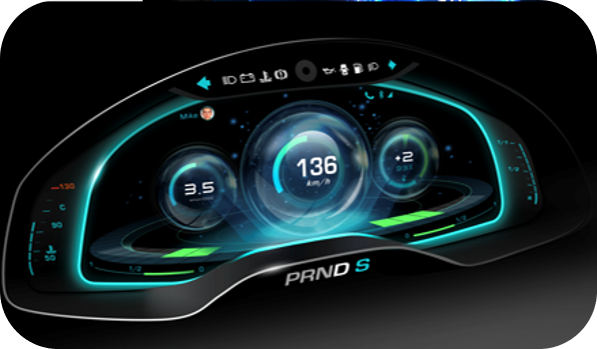
He chooses luminous gauges and a different information layout.
Illustrative individual design preferences. Both interface designs were built with NOAH; these screenshots illustrate appearance, not the cellphone design tool.
Use the cellphone app to personalize colours, graphics, layouts and displayed information. Drivers shape their own GUI, then apply it to the cockpit through NOAH.
Use the cellphone app to define responses to context. For example: “When it rains after dark, use my low-glare layout and bring navigation into focus.” Behavior can respond to time, weather, sensor inputs and driver state within the integrated vehicle scope.
Design your GUI and define context-based behavior
Apply the driver’s design immediately
Your appearance. Your defined responses.
Vehicle hardware and system binary remain unchanged. No restart or reboot.
02 / Display Coordination
Carry graphics and animation across cockpit displays with perspective aligned to the driver’s viewing position. Give your brand a visual experience that belongs to the whole cockpit.
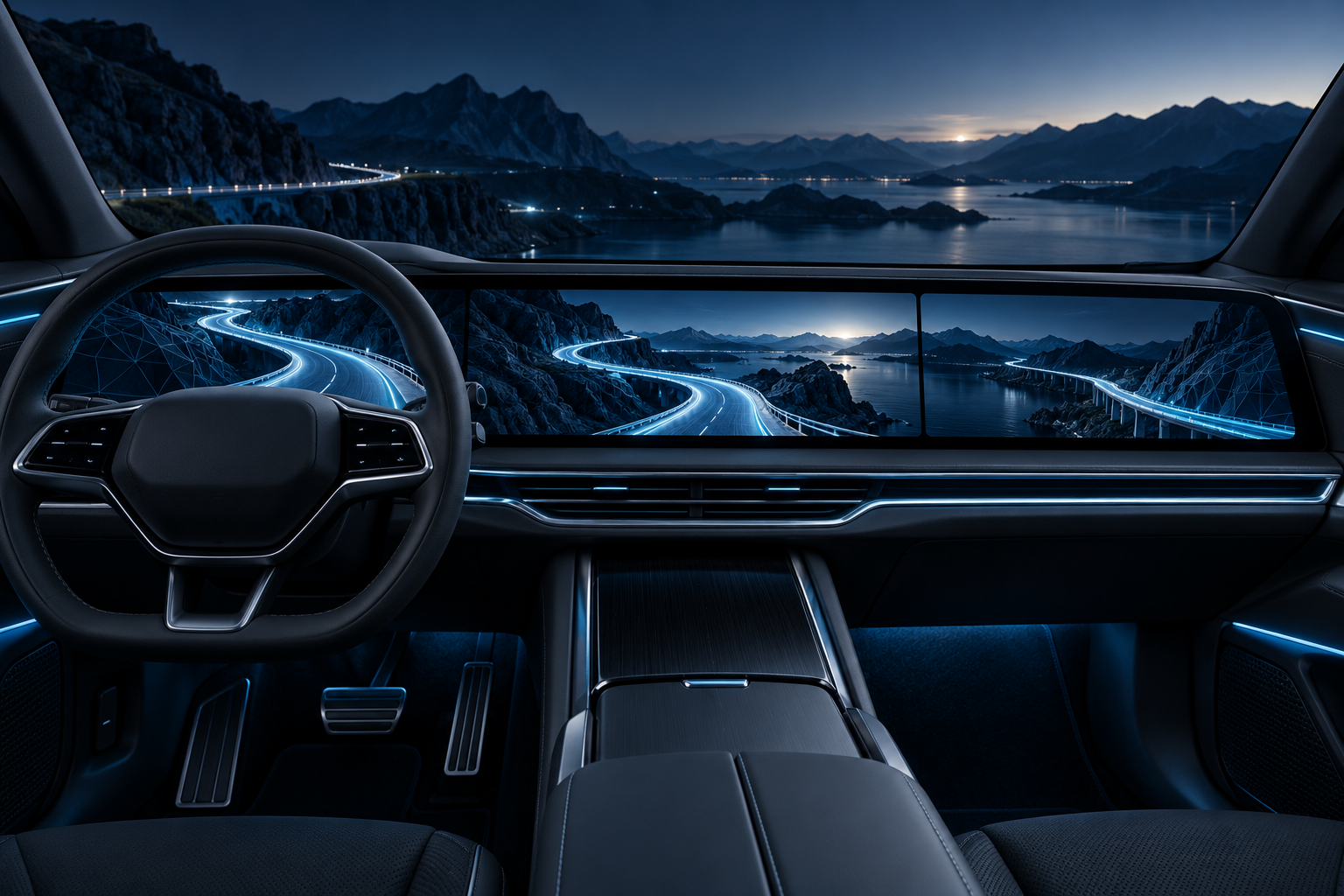
Display views are composed around a shared scene and viewing position, so the geometry reads as one connected view.
Move visual elements between screens as part of a coordinated animation.
Use depth, motion and display composition to create a cockpit identity beyond a flat instrument layout.
03 / Functions On Demand
An advanced path to designing your own experience: describe your preferred behavior in a prompt, and let FOD interpret it into personalized functions. It extends the cellphone app’s GUI and behavior design with prompt-based creation.
“When I look tired at night, simplify my display and suggest a rest stop.”
VibeMachine interprets the request and can coordinate HMI functions and vehicle systems to create a personalized UX. Available responses depend on the integrated vehicle functions.
LLM-assisted personalization is at proof-of-concept stage.
Explore VibeMachine / FOD →04 / Embedded Demonstrations
NOAH has been implemented on Renesas, Qualcomm and MediaTek platforms. Embedded performance has been measured; evaluation results can be reviewed against your target hardware and display workload.
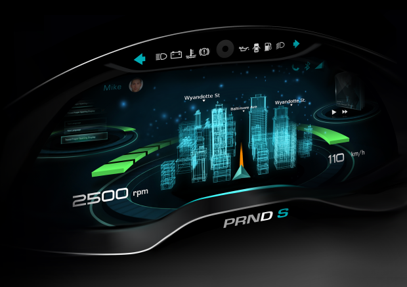
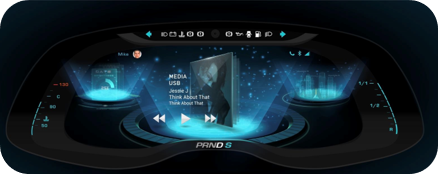
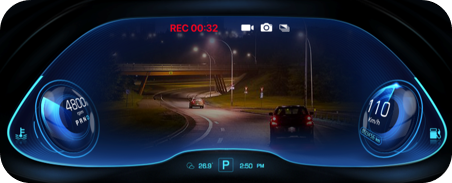
These examples show implemented graphics and display capabilities. The UX Apps Store below describes a proposed OEM business model.
05 / Oem Benefits
Use NOAH as the platform for an evolving cockpit experience business: give customers reasons to return, and give your brand room to introduce something new.
Create a recognisable cockpit identity—and extend it with new designs and behaviors over the vehicle’s life.
Let customers create their own GUI and behavior through a cellphone app. Extend the offering with manufacturer-created experiences and advanced prompt-based personalization.
Build paid experience collections or services around a platform customers can also use to create their own UX. An OEM-controlled store can distribute additional content; commercial results depend on the offering and demand.
Build on a common experience platform, with integration and validation defined for each vehicle and hardware configuration.
06 / Ux Apps Store
Drivers can design their own GUI and behavior with the cellphone app. A UX Apps Store adds another path: discover and download OEM or partner experiences, then personalize them. NOAH is the common platform that brings user-created and downloaded experiences into the cockpit.
Catalogue, pricing and customer relationship
Bring the selected UX package into the cockpit
New appearance and supported behavior
Vehicle hardware and system binary remain unchanged.
New visual worlds, layouts and display compositions.
Context-based HMI responses for supported vehicle functions.
Appearance and behavior designed to work together.
Additional commercial channel / The store distributes experiences; the cellphone app lets drivers create their own. Catalogue operations, package validation, distribution and commercial responsibilities are agreed with the OEM.
07 / NOAH Runtime Ota
Runtime-OTA updates HMI content and behavior immediately without a reboot. The change can come from a manufacturer’s OTA release or a user’s personalization request.
Release a revised interface, add a display experience, or update interaction behavior through the OEM’s secure telematics channel. NOAH applies the HMI update immediately without a reboot.
A driver designs a preferred GUI and behavior through the cellphone app. NOAH applies the resulting configuration immediately on the same vehicle, without rebuilding its system software or rebooting.
| What changes? | Traditional FOTA / SOTA | NOAH Runtime-OTA |
|---|---|---|
| Update payload | Firmware or software binaries | Supported HMI content and behavior packages |
| Taking effect | Binary updates commonly require a restart or reboot | UX behaviors change immediately without restart or reboot |
| Driver personalization | Often limited to manufacturer-provided presets and options | Drivers design their own GUI and behavior after delivery; OEM and store experiences can also be deployed |
| Update boundary | Changes to executable system software require system-level validation and protection | Experience updates retain the existing binary; package validation and security remain necessary |
Runtime-OTA complements firmware and system updates. It applies to supported experience changes; new underlying system capabilities may still require conventional software updates.
08 / Work With Mai
Choose the delivery model that fits your cockpit program. Start with a concrete driver experience, then assess it on the hardware you plan to use.
Engage MAI to build a NOAH-based dashboard and integrate the agreed driver experiences into your vehicle program.
MAI works with your nominated Tier-1 to integrate NOAH Runtime in their hardware platform.
Own the brand direction, customer offering, catalogue strategy and commercial decisions.
Provide NOAH, integration expertise, agreed experience development and lifecycle support.
Deliver agreed hardware, vehicle integration, experience content and program validation.
09 / Why Adopt Noah
What NOAH can demonstrate and deliver:
Start with existing UI examples, cross-display demonstrations and experience on several embedded platforms.
Evaluate NOAH’s memory use on your target workload, alongside frame rate, visual quality and display configuration.
Connect cellphone-based GUI and behavior design with immediate cockpit deployment. The same NOAH platform can support OEM-distributed experiences and an advanced FOD path—giving you a basis for more than a download catalogue.
Combine the platform with MAI’s integration work, experience development and agreed lifecycle services.
Evaluate NOAH alongside your current HMI framework using the same hardware, resolution, scene complexity, assets and animation. Review peak and steady-state memory, frame rate, startup and experience activation time.
Discuss an embedded benchmark →Evaluate NOAH
Tell us your target platform, display configuration and the GUI or behavior you want drivers to design. We can demonstrate the cellphone-to-cockpit path, define measurements and agree a delivery scope.
Discuss your cockpit program →